
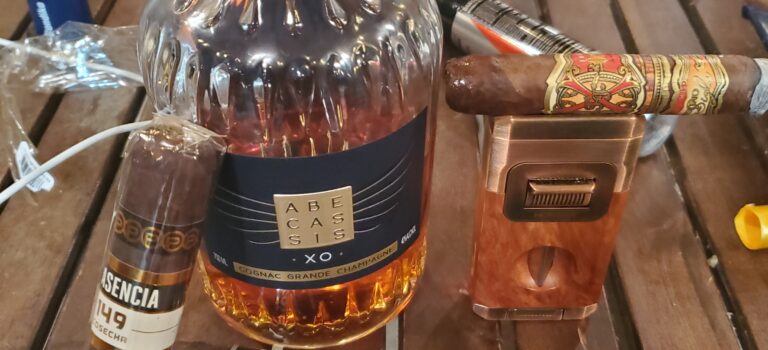
Some of the strongest relationships in my life began over a cigar. Twelve years, hundreds of miles and some of life’s hardest moments later, I’ve begun to understand why.
I met Jeff in a cigar shop that doesn’t exist anymore.
It was called SOMA.
More than twelve years later, I couldn’t tell you what cigar either of us was smoking when we met. I don’t remember what was playing on the television. I couldn’t reconstruct the conversation that started it.
But I can tell you this.
When my parents died, Jeff was sitting in the funeral parlor.
So were other brothers and sisters of the leaf.
That’s probably as good an explanation of the cigar lifestyle as I’ve ever come up with.
A Cigar Takes Time
Anyone who smokes a cigar regularly—or even occasionally—understands something that people outside the culture may not appreciate.
A cigar takes time.
Forty-five minutes. An hour. Sometimes two.
There aren’t many things left in our lives that ask us to sit still for that long.
And if you smoke more than once a week at the same cigar shop or lounge, do the math. You may spend several hours every week sitting around some of the same people.
At first, you talk about cigars.
What are you smoking?
Have you tried this one?
What did you think about that blend?
Then something happens.
The conversation wanders.
Sports. Business. Marriage. Kids. Travel. Food. Money. Politics. Something happening around the corner. Something happening halfway around the world.
Somebody says something you agree with.
Someone says something you don’t.
And because nobody is getting up after ten minutes, you actually have time to talk about why.
Then you come back a few days later.
Sometimes the conversation simply continues.
Do that for a few months—or a few years—and something has happened that you may not have noticed while it was happening.
You’ve built relationships.
The Greatest Luxury May Be Time
We use the word luxury a lot in the cigar world.
Rare tobacco. Beautiful humidors. Expensive spirits. Private lounges. Exotic destinations.
I appreciate all of it.
But I’m beginning to think the greatest luxury associated with a cigar may be something much simpler.
Time.
Time to sit.
Time to listen.
Time to disagree without immediately disappearing.
Time to tell a story badly and take fifteen minutes getting to the point.
Time to discover that the person you’ve been sitting beside every Thursday has lived a life completely different from yours.
Modern life is remarkably efficient at allowing us to encounter thousands of people without really knowing many of them.
The cigar lounge can work differently.
Not every lounge. Not every group. And certainly not every visit.
You have to find a place where you’re comfortable with the vibe and comfortable with the people.
But when you do, repetition does something.
The stranger becomes the familiar face.
The familiar face gets a name.
The name becomes a conversation.
And occasionally, the conversation becomes a friendship.
There’s Actually a Name for Places Like This
Sociologist Ray Oldenburg popularized the term “third place” for informal gathering places outside the two environments that dominate much of adult life: home and work.
Think cafés, neighborhood bars, barber shops and other places where regulars return not because they’re required to be there, but because they enjoy being there.
Conversation is central. So are regulars. The Project for Public Spaces’ discussion of Oldenburg’s work describes conversation as a primary activity of third places and regulars as essential to establishing their character.
Research has also examined the relationship between these kinds of gathering places, repeated social interaction and community cohesion. A study published in Social Science Research explored how third places can contribute to social interaction and cohesion within communities.
And, interestingly, researchers have looked specifically at cigar lounges.
A year-long ethnographic study published through the University of North Carolina Asheville examined communities inside two North Carolina cigar stores. The researcher found that cigar lounges can occupy precisely this space between home and work—places where ritual, specialized knowledge, relaxation and conversation help create social bonds among people who return to them. You can read the cigar-community study here.
I didn’t need an anthropologist to tell me cigar friendships were real.
But it helps explain why they happen.
The cigar gives us a reason to sit there long enough.
SOMA Is Gone. The Friendship Isn’t.
I met Jeff at SOMA more than twelve years ago.
Eventually life moved me south. I’ve lived in Decatur, Georgia, for the past ten years.
The shop where we met eventually closed.
That could easily have been the end of it.
It wasn’t.
Jeff and I remained close.
When business brought him to Georgia, we’d get together. There have been cigars at Red Phone Booth. Golf outings. Visits to Got Cigars, one of the local shops I frequent.
The geography changed.
The relationship didn’t.
For the last couple of years, I’ve traveled back to Rhode Island and we’ve taken in a Patriots game together. This November, we’re doing it again—this time with my wife along for the trip.
I’m sure we’ll smoke a cigar somewhere along the way.
But here’s what I’ve come to realize:
The cigar isn’t really the important part anymore.
Maybe it never was.
It simply created the circumstances for two people who might otherwise never have known one another to spend enough time together to discover that they enjoyed each other’s company.
Then life took over.
Brothers and Sisters of the Leaf
Jeff isn’t an isolated example.
I’ve participated in different cigar communities over the years, and I’ve watched variations of the same thing happen repeatedly.
People meet around the leaf.
Eventually they know each other’s spouses.
They play golf together.
They travel.
They celebrate birthdays.
They know when somebody hasn’t been around for a while.
They know when someone’s child graduates.
They know when somebody gets a new job.
And sometimes they know when someone’s world has just fallen apart.
When my parents passed, people I’d originally met through cigar culture showed up.
That matters to me.
Because there is an enormous difference between someone saying, “Sorry for your loss,” and looking up to see that person physically sitting in the room.
Nobody had to organize the cigar community.
Nobody handed out assignments.
Friends showed up because that’s what friends do.
Some of those friendships simply happened to begin with a cigar.
More Than Smoke
This is one reason I’ve never been particularly interested in building ThinkCigar around ratings alone.
There’s nothing wrong with wanting to know whether a cigar is worth smoking.
But after all these years, I’m much more interested in what happens around the cigar.
The cities it takes us to.
The history we discover.
The food sitting beside it.
The coffee poured before it.
The bourbon poured after it.
The people making the cigars.
The people selling them.
The people sitting in the chair next to us.
And the conversations that happen because neither person is in much of a hurry to leave.
That’s the part of cigar culture that’s difficult to explain to someone who has never experienced it.
From the outside, you see people sitting around smoking cigars.
From the inside, something else may be happening entirely.
Relationships are being built in increments of an hour at a time.
I’ve experienced that hospitality in unexpected places, too. Years ago, a work trip to Buffalo led me into a cigar shop as a stranger and out with a story about pizza, venison and people who made a visitor feel like a regular. It’s one of the reasons the places surrounding cigar culture can remain with us long after we’ve forgotten what we smoked that day.
The Cigar Lifestyle
Maybe that’s also why I’ve become increasingly particular about what I mean when I use the phrase cigar lifestyle.
It isn’t simply owning expensive cigars.
It isn’t a humidor.
It isn’t a bottle of bourbon.
It isn’t a leather chair in a beautiful lounge.
Those things can be wonderful.
But they’re accessories.
For me, the cigar lifestyle is the world that has grown around the leaf.
People. Places. Ritual. History. Food. Drink. Travel. Conversation. Time.
And, occasionally, friendship.
It’s also why I believe the ritual surrounding a cigar can matter as much as what’s actually burning. The time we make for it creates space for everything else to happen.
And it’s why Smoke, Sip & Savor has become part of how ThinkCigar explores the lifestyle: not simply what we’re smoking or drinking, but where we are, who we’re with and what we discover along the way.
This November, my wife and I will head to Rhode Island. Jeff and I will go to another Patriots game, as we’ve done for the last couple of years.
There will be laughter.
Probably some disagreement about something.
Almost certainly food.
And I’m betting somewhere along the way there will be a cigar.
Twelve years ago, the cigar mattered because it gave two strangers something to talk about.
Today?
The cigar was just the introduction.
About Post Author

